
Infrastructure Intelligence · 4 March 2026 · 7 min read
Hosting, ASN and Domain Records as Investigative Signals
By Digital Asset Claims Research Desk·Investigation Team
- Infrastructure
- Domain Records
- ASN
- Hosting
Websites can be taken down in minutes, but the infrastructure records behind them often remain accessible for months or years. This article examines how hosting, ASN and domain data are used to establish technical patterns across fraudulent platforms.
A fraudulent website can disappear overnight. The domain registrar's records, the ASN allocation, and the certificate transparency log generally do not.
What Domain Records Reveal Over Time
Registration date, registrar choice, and historical name server changes together form a timeline that can be compared against the platform's own claimed launch date and operating history.
Privacy-protected WHOIS records still disclose registrar and infrastructure metadata even when the registrant's personal details are withheld, and this metadata alone can be diagnostic.
Historical WHOIS snapshots, where accessible, allow investigators to detect changes in registration details over time, which can indicate a change of control or an attempt to obscure earlier ownership.
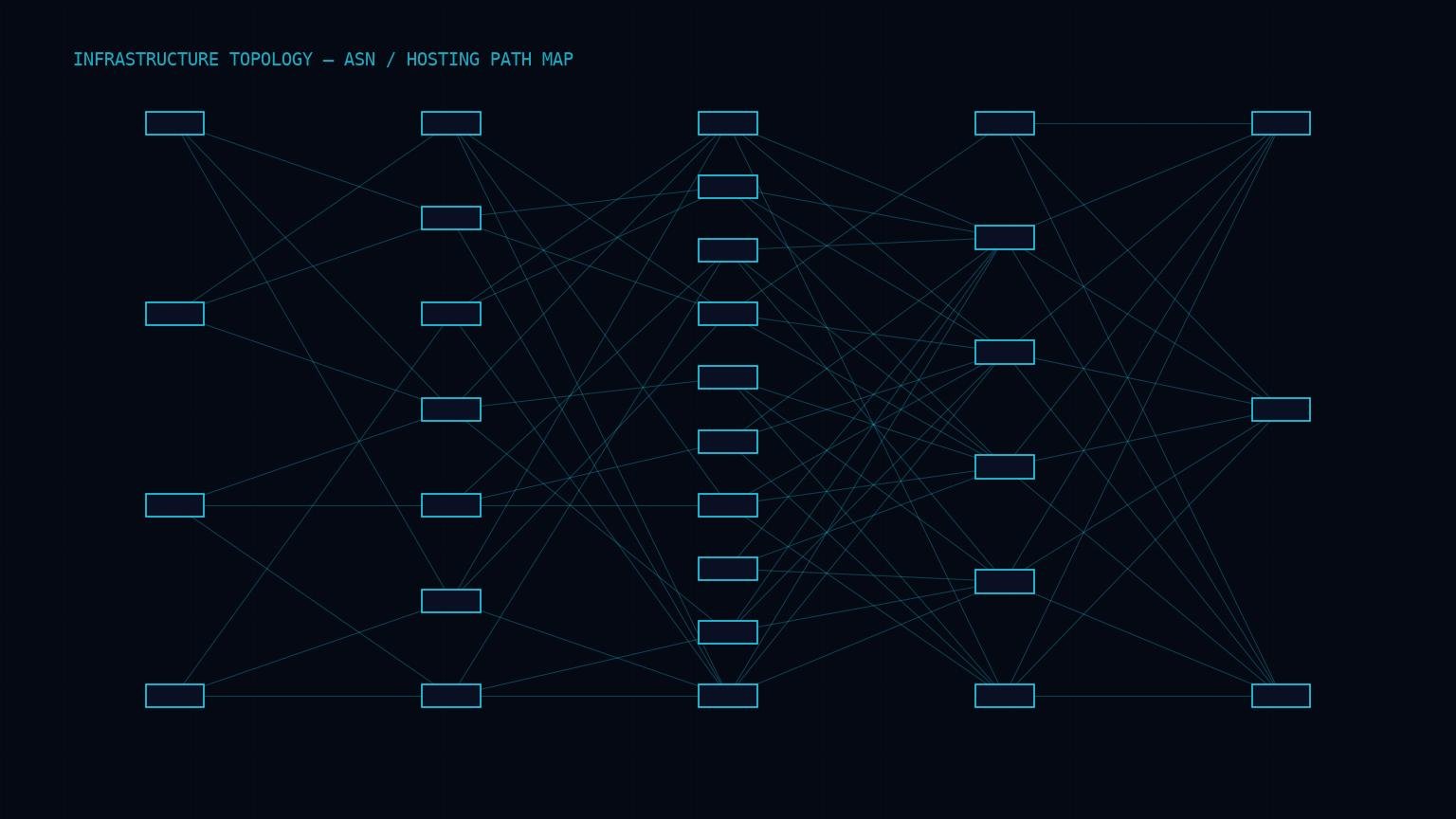
ASN Allocation as a Clustering Signal
Every routable IP address belongs to an autonomous system, and identifying which ASN hosts a given platform is a straightforward technical step that yields a durable, comparable data point.
Clustering multiple fraudulent platforms by shared ASN, particularly narrow or unusual allocations, often reveals operational relationships that are not visible from the platforms' public-facing content alone.
This clustering is strongest as evidence when combined with independent timing data, such as registration dates falling within a similar window across the clustered platforms.
Certificate Transparency as an Immutable Timeline
Certificate authorities are required to log issued certificates in public, append-only transparency logs, creating an independently verifiable record of when a domain first secured a valid certificate.
This timeline is useful for testing a platform's claimed history, since a domain claiming years of operation but showing a certificate issued only weeks earlier presents an inconsistency worth investigating.
Because these logs are maintained independently of the domain operator, they cannot be retroactively edited to obscure an inconvenient timeline, unlike content hosted on the site itself.
Presenting Infrastructure Findings Responsibly
Infrastructure findings are documented as a set of dated, sourced technical facts, with any inference about shared operational control stated separately and clearly labelled as an inference.
This separation allows a reader to distinguish between what has been directly observed, such as a shared ASN, and what has been concluded from a pattern of such observations.
Where infrastructure findings support a request to a registrar or hosting provider for record preservation, the request is framed around the specific technical facts rather than an unproven identity claim.
Infrastructure data sources and their persistence
| Source | Typical persistence | Investigative use |
|---|---|---|
| WHOIS / domain records | Often years, subject to privacy redaction | Registration timeline, registrar patterns |
| ASN allocation | Stable while hosting relationship continues | Clustering related platforms |
| Certificate transparency logs | Permanent, append-only | Independent operational timeline |
| DNS / name server history | Variable, dependent on archiving | Infrastructure reuse detection |
Frequently asked questions
Can domain privacy protection fully hide an operator's identity?
It can obscure personal registrant details from public view, but registrar records are still held by the company and may be disclosed through formal legal process. Metadata such as registration timing remains visible regardless.
How reliable is ASN clustering as evidence?
It is a strong pattern indicator when combined with other data, such as registration timing, but shared hosting alone does not prove common ownership, since many unrelated operators legitimately use the same providers.
Are certificate transparency logs searchable by the public?
Yes, several public tools allow searching certificate transparency logs by domain, which makes this data accessible without specialised access.
What happens once infrastructure patterns are documented?
They typically inform preservation requests to hosting providers or registrars and are incorporated into the broader case file alongside on-chain and OSINT findings.
Infrastructure data offers a durable, independently verifiable layer of investigative signal that survives the takedown of the fraudulent platform itself. Used to establish patterns rather than identities, hosting, ASN and domain records materially strengthen an investigation's factual foundation.