Timeline Reconstruction · 20 April 2026 · 8 min read
Timeline Reconstruction Across Mixed Digital Records
By Digital Asset Claims Research Desk·Investigation Team
- Digital Evidence
- Timeline Analysis
- Methodology
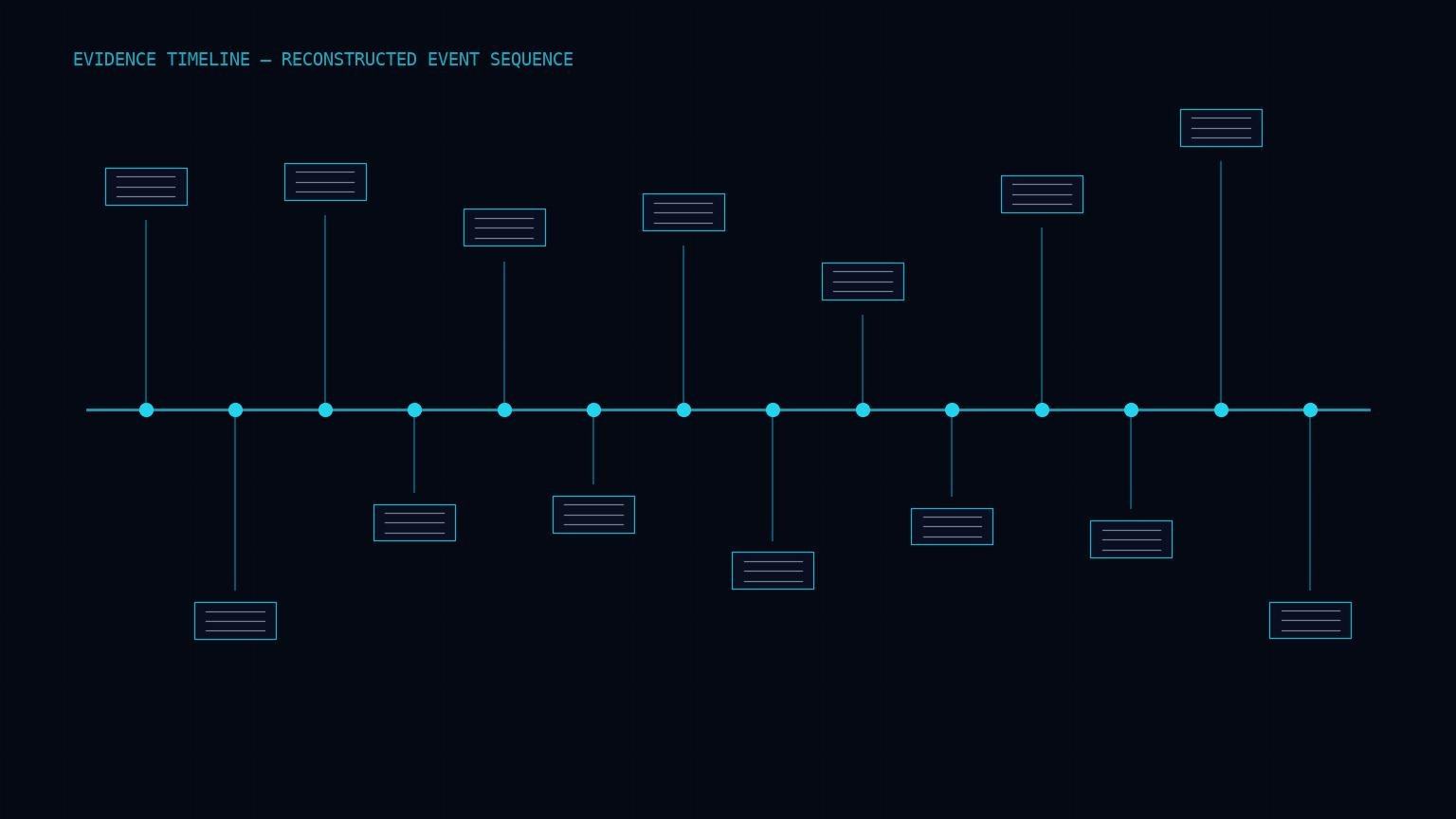
Digital investigations rarely rest on one type of record. This article explains how a single, reconciled timeline is built from blockchain data, platform logs, and open-source material, and why timestamp handling deserves particular care.
Different systems keep time differently. Reconciling them correctly is a prerequisite for any cross-source finding.
Why mixed sources create timing risk
Blockchain networks, exchange platforms, and open-source content each record time according to different standards, some using coordinated universal time, others using local server time or a viewer's device settings.
Where these sources are combined without careful reconciliation, events can appear to occur in the wrong order, which can materially distort the narrative built from the combined record.
Recognising this risk at the outset of a multi-source investigation is what prompts the deliberate reconciliation step, rather than assuming timestamps can simply be compared as they appear in each system's native display.
Reconciling blockchain and platform timestamps
Blockchain timestamps are set by the entity producing a block and are subject to network-level validation rules that constrain, but do not eliminate, natural variance from true wall-clock time by a margin of a few minutes.
Exchange platform logs typically record server time, which must be confirmed against the platform's documented time zone configuration, sometimes obtained directly from the platform under lawful process where it is not otherwise disclosed.
Once both are converted to a single reference time zone, they can be placed on the same timeline with a documented margin of uncertainty attached to the blockchain-derived entries specifically.
Handling open-source material carefully
Social media posts and forum content often display a timestamp reflecting the viewer's local settings rather than a fixed, portable value, which must be resolved before the content can be placed reliably on a timeline.
Where possible, the platform's own metadata, retrieved through its published interface or archived snapshots, is used to establish the true creation time, rather than relying on the timestamp shown in a screenshot.
Content that cannot have its timing independently verified is still recorded, but flagged clearly as having an uncertain position on the timeline, rather than placed with false precision.
Investigating gaps and apparent contradictions
When the reconciled timeline reveals an apparent conflict, such as a platform login recorded after a withdrawal it should logically have preceded, the discrepancy is investigated rather than adjusted to fit the expected narrative.
Some apparent contradictions resolve into known clock drift or reconciliation error once checked; others reveal a genuine inconsistency that becomes an important investigative finding in its own right.
Either way, the investigation documents both the discrepancy and its resolution, so a reader can see exactly how an apparent inconsistency in the record was addressed rather than silently corrected.
Timestamp handling by source type in a mixed-record timeline
| Source type | Native time reference | Reconciliation step | Residual uncertainty |
|---|---|---|---|
| Blockchain block data | Miner or validator clock | Convert to UTC, note network variance | A few minutes |
| Exchange platform logs | Server time | Confirm server time zone, convert to UTC | Low, once confirmed |
| Open-source social content | Viewer display setting | Retrieve platform metadata where possible | Variable, sometimes high |
| Email or correspondence headers | Sender or server timestamp | Cross-check header fields against known standards | Low to moderate |
Frequently asked questions
Why can't timestamps just be compared directly across sources?
Different systems record time using different standards and conventions. Direct comparison without reconciliation risks misordering events and distorting the investigation's findings.
How reliable are blockchain timestamps?
They are generally reliable but carry a natural variance of a few minutes due to how blocks are produced and validated, which is documented rather than ignored.
What happens when a timestamp cannot be verified?
The event is still recorded, but flagged as having uncertain timing, rather than being placed on the timeline with unjustified precision.
Are timeline contradictions always errors?
No. Some resolve into known clock discrepancies, but others reveal genuine inconsistencies worth investigating as findings in their own right.
A reconciled, multi-source timeline is one of the most useful structural tools in a digital investigation, but only if timestamp handling is treated with the same rigour as the underlying evidence itself. Careful reconciliation, not convenient assumption, is what makes a combined timeline defensible.