29 Jan 2026 · 7 min read
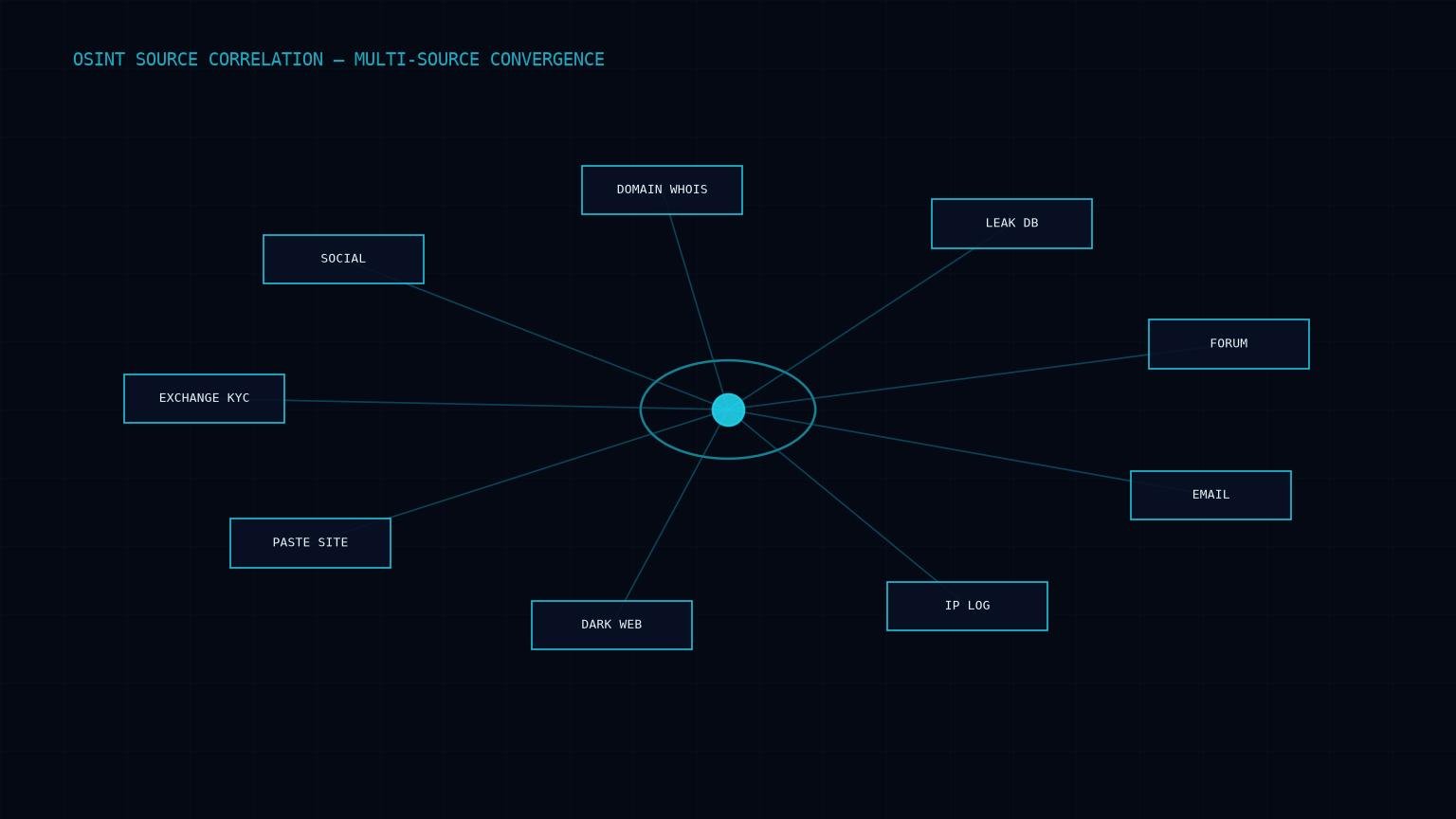
Source Verification in Open Source Research
Not all public information is equally reliable. This article sets out how sources are tiered, tested and documented before they are allowed to inform a finding.
Read article →
Open source collection, source grading and corroboration methods used to place on-chain activity in a wider factual context.
29 Jan 2026 · 7 min read
Not all public information is equally reliable. This article sets out how sources are tiered, tested and documented before they are allowed to inform a finding.
Read article →
8 Jan 2026 · 8 min read
Open source intelligence supplies the contextual layer that on-chain data alone cannot provide, but only when collection is disciplined and sources are corroborated.
Read article →Blockchain Intelligence
How ledger data is read, normalised and reconstructed into an ordered account of transfers, contract calls and cross-chain movement.
Digital Asset Investigations
Case-level analysis: how an investigation is scoped, how fragmented trails are rebuilt, and what an investigation can and cannot establish.
Wallet & Transaction Analysis
Address behaviour, funding history, clustering signals and the distance between what a wallet shows and what it proves.
Digital Evidence
Evidence graphs, timelines, integrity and custody: how digital records are captured, linked and kept reproducible.
Infrastructure Intelligence
Domains, hosting, ASN and IP indicators as investigative signals, and the evidential limits that apply to each of them.
AI Investigation Technology
Machine-assisted correlation, entity resolution and graph analysis, and the human verification that must follow every model output.
Evidence & Verification
Corroboration, conflicting sources and confidence classification: how a finding is graded before it enters a report.