
OSINT · 8 January 2026 · 8 min read
The Role of OSINT in Digital Asset Investigations
By Digital Asset Claims Research Desk·Investigation Team
- OSINT
- Open Source Research
- Investigations
- Corroboration
Open source intelligence is frequently misunderstood as simply searching the internet. In a digital asset investigation it is a structured discipline with its own standards of collection, corroboration and documentation, and its findings carry weight only in proportion to how rigorously those standards are applied.
Public visibility does not equal reliability. OSINT earns its place in an investigation through disciplined sourcing, not volume.

What Counts as an Open Source in This Context
Open sources include anything accessible without special authorisation: forum threads, cached web pages, domain records, social media profiles, press coverage, and public regulatory filings. The defining feature is public accessibility, not necessarily ease of discovery.
Some open sources require specialised tooling to locate, such as certificate transparency logs or historical DNS records, even though the underlying data is technically public. Access difficulty does not change the classification, only the collection method required.
Analysts distinguish between primary sources, such as an exchange's own published statement, and secondary sources, such as a news article summarising that statement. Primary sources are preferred wherever they can be located and verified directly.
Building a Defensible Collection Record
Every piece of OSINT material entered into a case file is logged with its URL, retrieval date, collection method, and an archived copy where the tooling allows. This record is what makes the finding reproducible rather than anecdotal.
Archiving matters because online content is transient. Scam sites are taken down, forum posts are deleted, and social accounts are suspended, often shortly after they attract investigative attention, which makes contemporaneous capture essential.
A defensible record also notes what was not found: searches conducted without results are documented, since an absence of corroborating material is itself a relevant data point when weighing confidence in a claim.
Corroboration Across Independent Channels
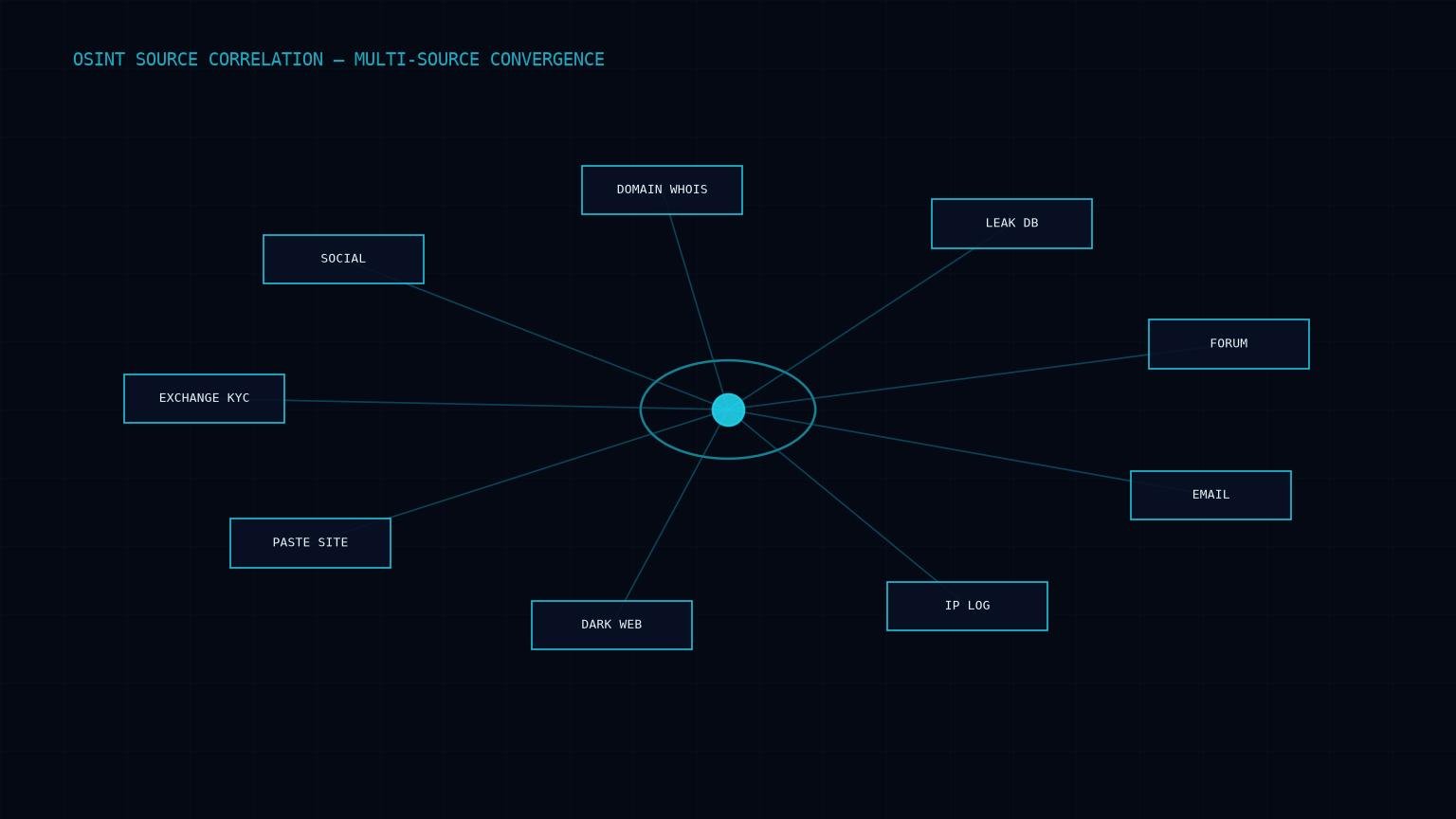
A finding gains investigative weight when it appears across sources that have no apparent relationship to one another. Two forum posts copied from the same original claim do not count as independent corroboration.
Investigators actively test whether apparently independent sources trace back to a common origin, since duplicated claims can create an illusion of consensus that does not reflect genuine verification.
Where corroboration cannot be established, the finding is retained in the case file but flagged at a lower confidence tier, ensuring the eventual report does not overstate what the evidence supports.
Integrating OSINT With On-Chain Findings
OSINT is most useful when it is tested against blockchain data rather than treated as a separate track of enquiry. A candidate identity found through open research should be checked against wallet activity timing, transaction counterparties, and known infrastructure.
Discrepancies between OSINT narrative and on-chain behaviour are informative in their own right, sometimes revealing that a publicly claimed identity does not match the technical pattern of activity observed on the ledger.
The combined picture, built from both disciplines and clearly attributing which parts of the narrative come from which source type, is what supports a report suitable for use beyond the investigation team.
Frequently asked questions
Is information found through OSINT admissible as evidence?
Admissibility depends on jurisdiction and the forum in which material is presented. Proper documentation of source, timestamp and retrieval method improves the material's standing, but legal admissibility is a determination made by counsel or the relevant tribunal, not by the investigator.
How is fabricated or planted information identified?
Analysts look for inconsistencies in timing, unnatural clustering of supposedly independent sources, and content that appears designed to mislead investigators toward a particular conclusion. No method eliminates the risk entirely, which is why single-source claims are treated cautiously.
Can OSINT alone identify the operator of a fraudulent scheme?
Rarely in isolation. OSINT typically produces candidate identities or infrastructure links that require further corroboration through technical and, where available, legal channels before an identification can be treated as established.
How long does OSINT collection take in a typical case?
It varies with the scale of online activity associated with the case, but disciplined collection with proper documentation generally takes longer than a cursory search, because each finding requires verification before inclusion in the case file.
OSINT contributes essential context to digital asset investigations, but its value depends entirely on the discipline applied during collection. Sourced, timestamped, and corroborated findings support sound conclusions; unverified mentions treated as fact undermine them. Used correctly, OSINT complements blockchain analysis rather than substituting for it.