
Wallet Analysis · 2 March 2026 · 7 min read
What a Wallet Address Can and Cannot Prove
By Digital Asset Claims Research Desk·Investigation Team
- Wallet Transaction Analysis
- Evidence Standards
- Attribution
Wallet analysis is central to digital asset investigations, but it is frequently misunderstood as identity evidence. This article separates what wallet-level data proves from what requires corroboration beyond the blockchain.
A wallet proves that someone held a key. It does not prove who that someone was.
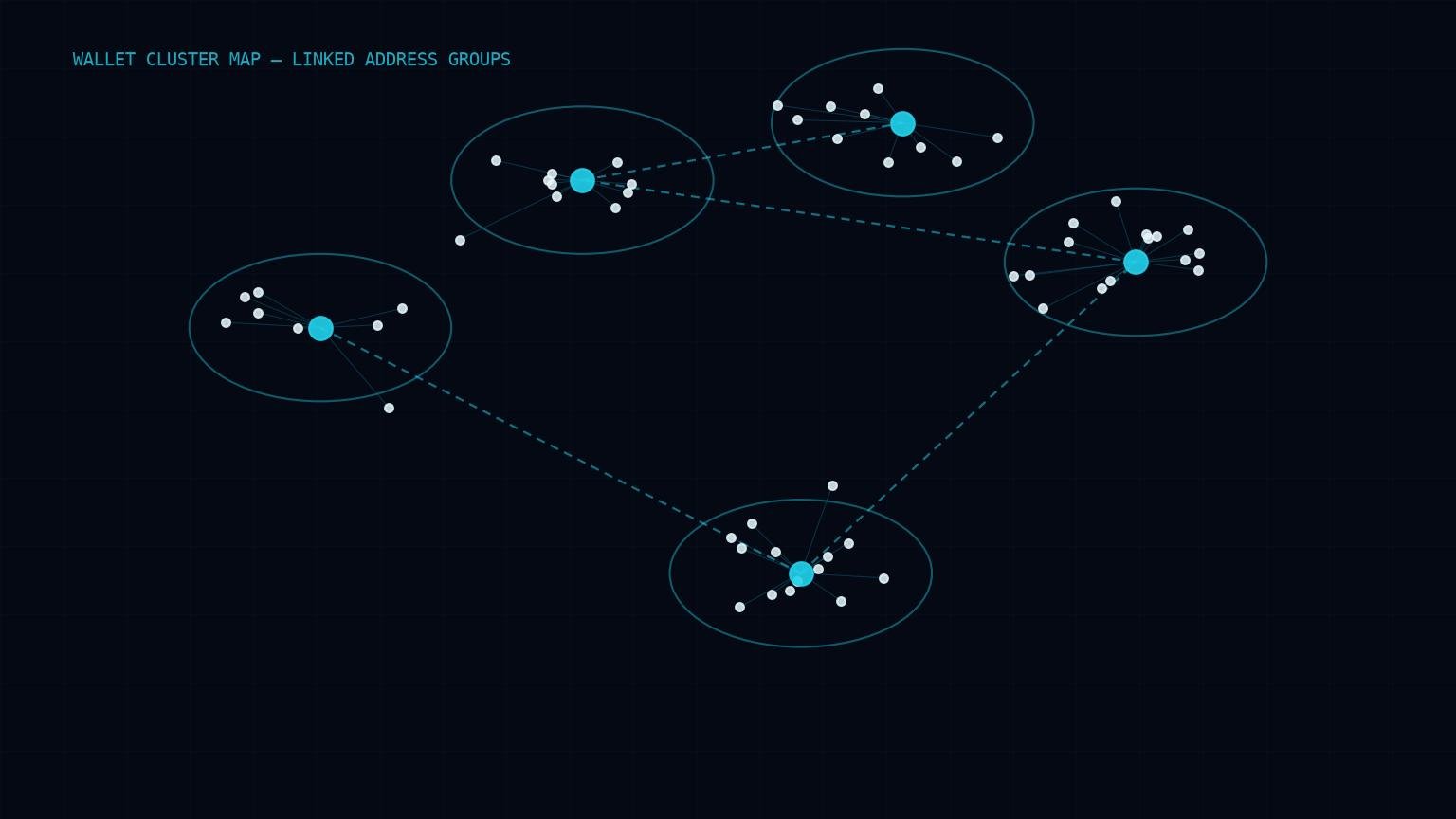
What a wallet address technically represents
A wallet address is derived mathematically from a public key, itself derived from a private key. Whoever controls that private key can authorise transactions from the address, and the network verifies this cryptographically without reference to identity.
This means the blockchain's guarantee is about control of a key, not about the person behind it. Two people could, in principle, share a private key, and the network would record their combined activity as a single address's history.
Understanding this distinction is the starting point for any wallet analysis, because it defines precisely what the underlying data can and cannot answer without further evidence.
Behavioural analysis and its limits
Analysts examine transaction timing patterns, typical transaction sizes, fee-setting behaviour, and address reuse habits to build a behavioural profile for a wallet, which can then be compared against other wallets of interest.
When multiple independent behavioural markers align consistently between two wallets, the probability that they share a common controller rises, though it remains a probability rather than a certainty until corroborated externally.
Automated or scripted wallets, such as those used by exchanges or trading bots, exhibit distinctive, highly regular patterns that must be distinguished from human-operated wallets before any comparison is drawn.

Clustering heuristics and false positives
Common-input-ownership heuristics assume that addresses spent together in a single transaction share a controller, which usually holds true but is not guaranteed, particularly in transactions designed to obscure ownership.
Coinjoin-style transactions, deliberately structured to combine inputs from unrelated parties, are a known source of false-positive clustering results, and analysts flag any cluster touching such transactions for additional scrutiny.
Exchange withdrawal batching, where many customer withdrawals are combined into fewer on-chain transactions for efficiency, can also produce misleading clustering signals if not correctly identified as an exchange process.
Moving from wallet pattern to attribution
Attribution, connecting a wallet to a named individual or entity, requires evidence beyond the wallet's transaction history: exchange account records, device data, or documented admissions obtained through lawful means.
Even strong behavioural correlation between wallets should be reported as an investigative lead requiring corroboration, not as a standalone finding of common ownership, until that corroboration exists.
The final wallet analysis report separates the cryptographically certain layer, control of the address, from the probabilistic layer, likely relationships to other wallets, and from the corroborated layer, confirmed identity where available.
Layers of wallet-related evidence and what each layer establishes
| Evidence layer | What it establishes | Certainty | Requires corroboration for identity |
|---|---|---|---|
| On-chain transaction history | Control of the private key over time | Certain | Yes |
| Behavioural fingerprinting | Likely common control across wallets | Probabilistic | Yes |
| Address clustering heuristics | Probable grouping of related addresses | Probabilistic, false positives possible | Yes |
| Exchange KYC records | Named account holder for an address | High, subject to lawful process | Provides the corroboration |
Frequently asked questions
Can two wallets with similar behaviour be proven to belong to the same person?
Similar behaviour raises the probability but does not prove common ownership. Corroborating evidence is needed to move from probability to a confirmed finding.
Does clustering software make attribution automatic?
No. Clustering tools produce probabilistic groupings that still require manual review and external corroboration before being reported as findings.
Can a wallet have more than one controller over its lifetime?
Yes. Private keys can be transferred, inherited, or shared, meaning the controller at one point in a wallet's history may differ from the controller at another.
Why do exchange withdrawal patterns complicate clustering?
Exchanges often batch multiple customer withdrawals into a single transaction, which can create misleading clustering signals if not identified as an exchange process.
Wallet analysis is powerful for establishing patterns of control and likely relationships between addresses, but it stops short of identity. Reports that respect this boundary, and pair wallet evidence with proper corroboration, produce findings that hold up under scrutiny.