Blockchain Tracing · 5 January 2026 · 8 min read
Reconstructing a Blockchain Transaction Trail
By Digital Asset Claims Research Desk·Investigation Team
- Blockchain Intelligence
- Transaction Tracing
- Evidence Standards
A blockchain transaction trail is built hop by hop from verifiable ledger data. This piece sets out the method used to reconstruct one, the checkpoints applied at each step, and the point at which inference has to be labelled as inference rather than fact.
Every trail begins with a confirmed hash and ends with a documented confidence level, not a conclusion dressed up as certainty.
Starting from the confirmed hash
Reconstruction begins with a single object: a transaction hash that has been independently verified against a full node or a reputable block explorer cross-checked against raw block data, never taken on trust from a secondary source alone.
From that hash the analyst extracts the full set of inputs and outputs, the fee paid, the block height, and the timestamp. These fields are recorded verbatim before any interpretation is attempted, so the raw evidentiary layer stays separate from the analytical layer above it.
This separation matters later. If an inference is challenged, the underlying raw data remains intact and can be re-examined independently of whatever conclusion was drawn from it during the original analysis.
Following the flow of funds
Forward tracing follows outputs to their next spend; backward tracing follows inputs to their originating transactions. Both directions are pursued where the investigative question requires it, and both are logged with the same rigour.
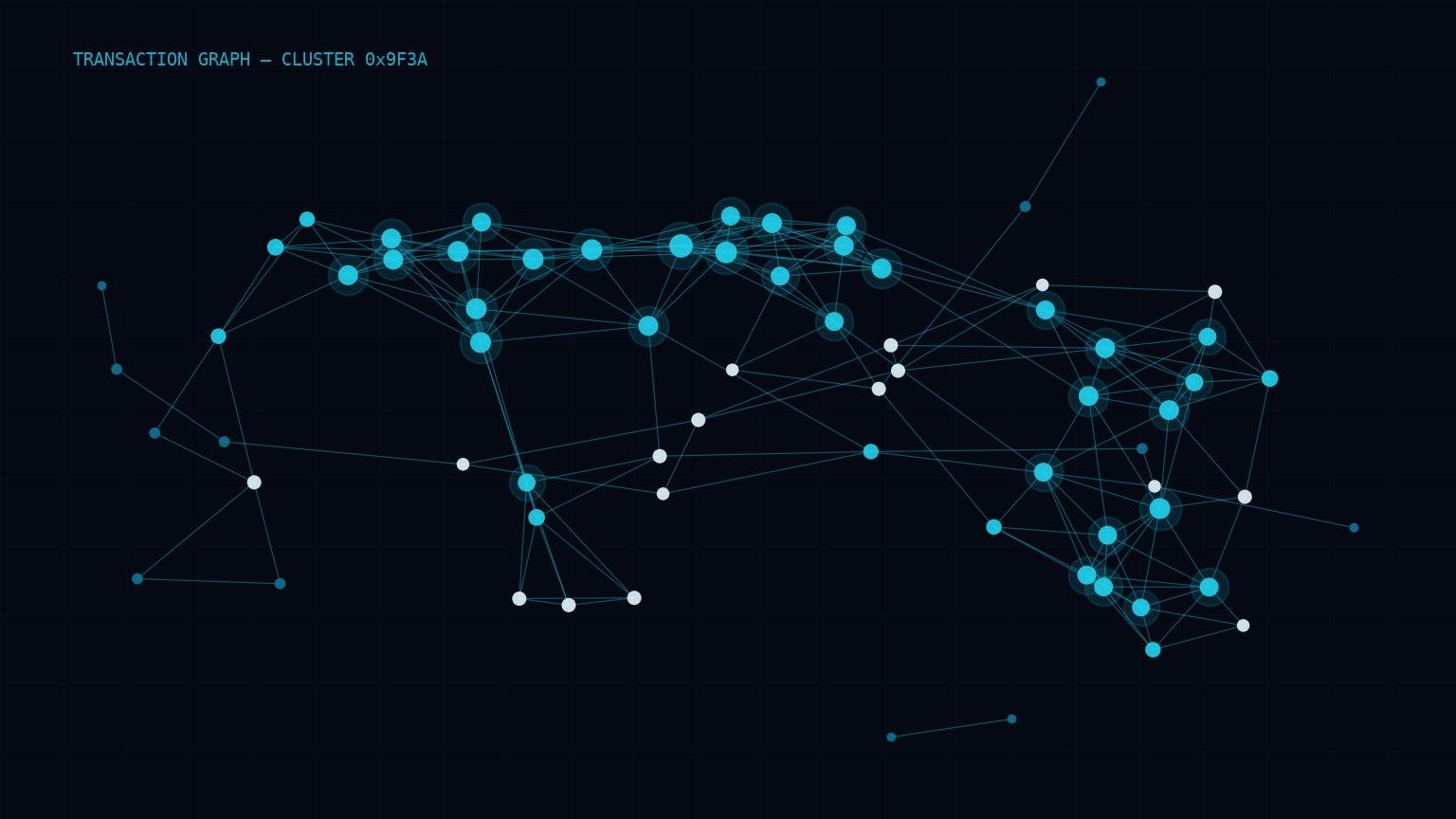
Address clustering heuristics, such as common-input-ownership, can group addresses likely controlled by one entity, but a heuristic result is recorded as a probability, never promoted to a stated fact within the trail.
Where a wallet interacts with a known exchange deposit address, that observation narrows the field of possible custodians, but it identifies an account holder only once matched against exchange records obtained through proper legal channels.
Handling obfuscation and breaks in the chain
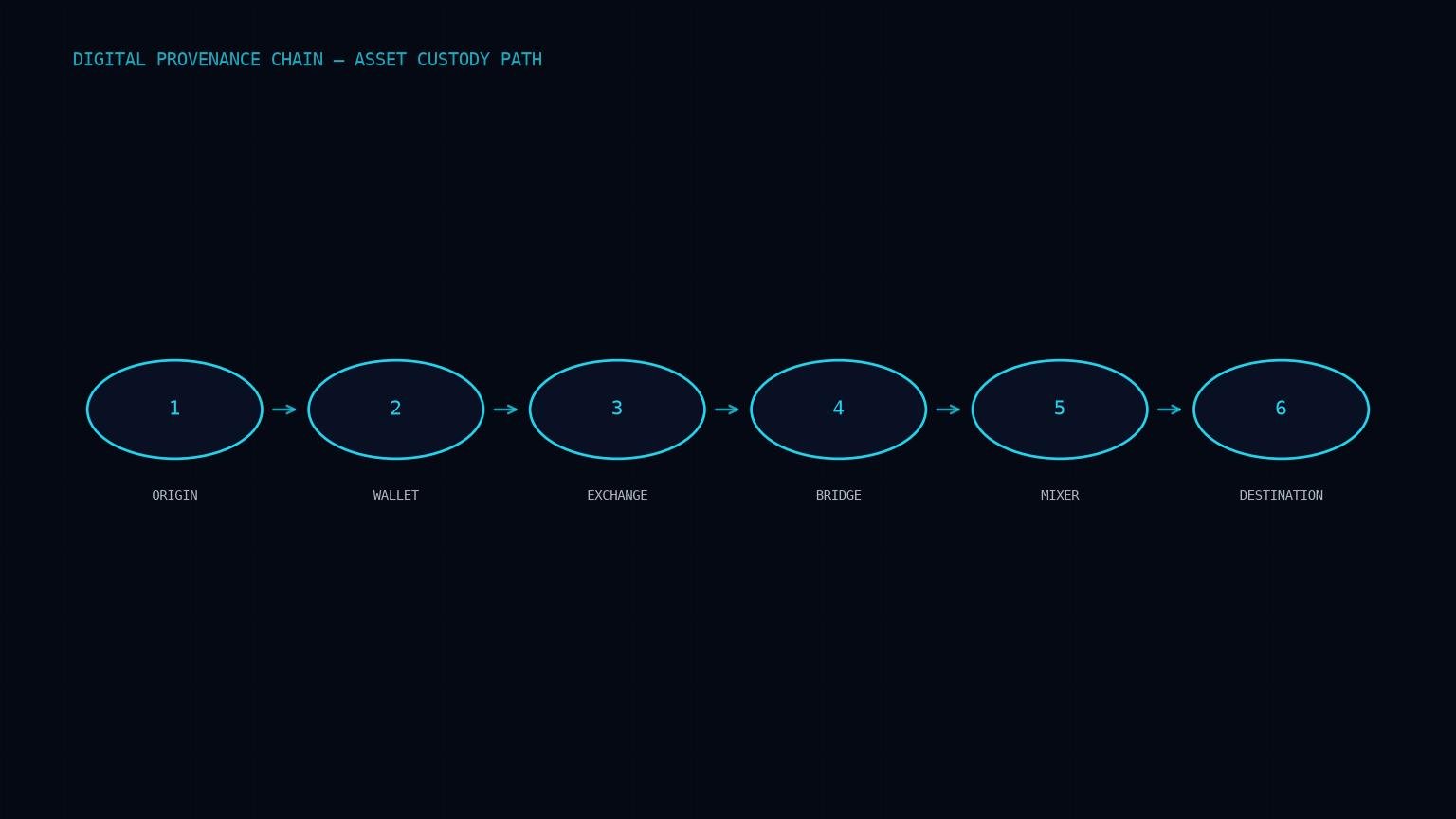
Mixing services, privacy coins bridged into the trail, and rapid cross-chain swaps are common obstruction techniques. Each is documented as a distinct break point rather than glossed over or bridged with a guess.
When a trail cannot be extended past an obfuscation layer using on-chain data alone, the investigation turns to off-chain corroboration: infrastructure logs, exchange KYC records under lawful process, or open-source references that independently place the same funds elsewhere.
A documented break is still useful. It tells a court or a client exactly where the on-chain evidence ends and where any further conclusion would depend on information outside the ledger.
Assigning and reporting confidence
Confidence is assigned per hop using a fixed scale: confirmed direct transfer, probable clustering inference, or unconfirmed/speculative. This scale is applied consistently across the whole trail so a reader can see exactly where certainty declines.
The finished report separates what the ledger proves from what analysis suggests. A wallet address moving funds to another wallet is proven; who controls either wallet is a separate question requiring separate evidence.
This structure is what allows a transaction trail to function as an evidentiary exhibit rather than a narrative summary, because every claim in it can be traced back to a specific, checkable data point.
Confidence classification applied to each hop in a reconstructed trail
| Confidence level | Basis | Typical evidence | Reporting language |
|---|---|---|---|
| Confirmed | Direct on-chain transfer | Transaction hash, block confirmations | Stated as fact |
| Probable | Heuristic clustering | Common-input-ownership pattern | Stated as likely, with caveat |
| Corroborated | On-chain plus external record | Exchange records under lawful process | Stated as established |
| Unconfirmed | Obstructed or mixed flow | No independent verification available | Stated as a break point |
Frequently asked questions
Can a transaction trail identify a person?
On its own, no. A trail identifies wallets and transfers. Linking a wallet to a named person requires corroborating evidence such as exchange account records or infrastructure data obtained lawfully.
What happens when funds pass through a mixer?
The trail is documented as broken at that point. Any continuation relies on off-chain corroboration rather than on-chain inference alone.
How is a trail verified independently?
Every hash, address, and timestamp cited is checkable against the public ledger, allowing a second analyst to reproduce the same result from the same raw data.
Does a longer trail mean stronger evidence?
Not necessarily. A short trail with confirmed corroboration at every hop is stronger evidence than a long trail containing unverified heuristic jumps.
A blockchain transaction trail is a disciplined, checkable reconstruction, not a story fitted around a suspicion. Its value comes from treating every hop as a claim requiring evidence, grading confidence honestly, and stating plainly where the ledger's own record runs out.