Provenance · 19 January 2026 · 7 min read
Digital Provenance and Blockchain Evidence
By Digital Asset Claims Research Desk·Investigation Team
- Blockchain Intelligence
- Provenance
- Digital Evidence
Provenance work asks where a digital asset came from and how it reached its current state. This article sets out the evidentiary layers involved and the discipline needed to avoid mistaking a plausible story for a proven history.
A ledger entry shows movement. It does not show motive, ownership, or legitimacy — those require separate, corroborated evidence.
Defining provenance for a digital asset
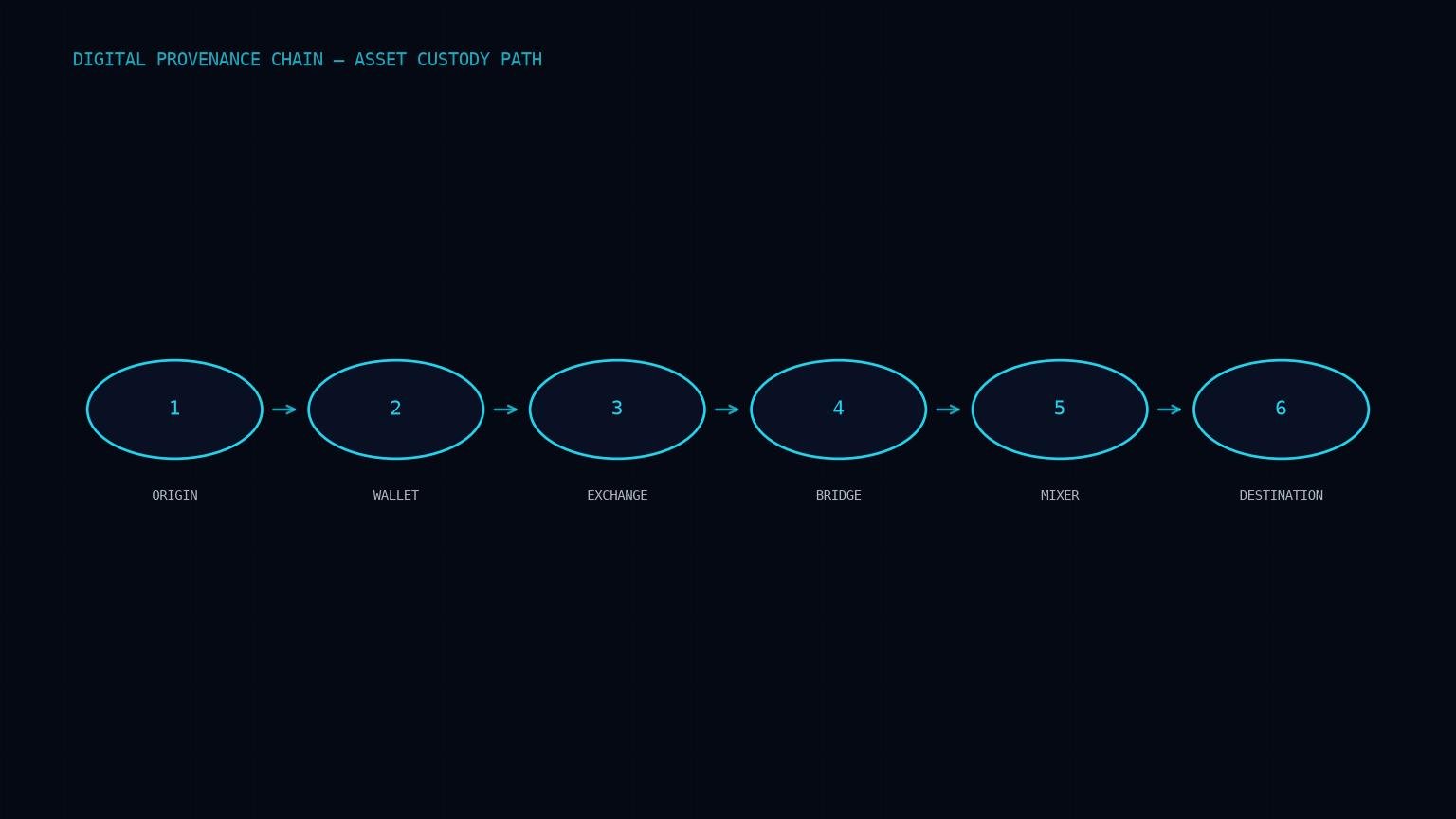
Provenance is the reconstructed history of custody and transfer, anchored to verifiable events. For a digital asset this includes minting or issuance, each subsequent transfer, and any point at which control appears to change hands.
Unlike a physical asset, a digital asset's provenance record is partly self-documenting through the blockchain, but that self-documentation covers only the technical fact of transfer, not the human context surrounding it.
Investigators therefore treat the chain as one evidentiary layer among several, always to be read alongside exchange records, infrastructure data, and open-source material where those exist and can be lawfully obtained.
Tracing to origin
Genesis tracing follows an asset backward through every recorded transfer until it reaches its earliest identifiable state on-chain, whether that is a mint event, a mining reward, or a bridge deposit from another network.
Each backward step is checked against block data directly, and any point at which the trail forks or becomes ambiguous is recorded rather than resolved by picking the more convenient branch.
For assets that have crossed between chains via a bridge, the bridge's own transaction records are treated as a separate evidentiary source requiring its own verification, since bridge mechanics vary widely in transparency.

The limits of metadata
Off-chain metadata describing an asset's attributes or claimed ownership can be hosted on servers or file systems outside the blockchain's control, meaning it can be changed after the fact without altering the underlying ledger entry.
A provenance finding resting solely on such metadata is flagged at a lower confidence level than one resting on the immutable transaction record, and the report states this distinction explicitly rather than presenting both as equally reliable.
Where metadata is pinned to decentralised, content-addressed storage, its integrity can be checked against the content hash, which materially raises confidence compared with metadata hosted on a mutable server.
Corroborating with external records
Exchange disclosure records, obtained through lawful process, can confirm whether a given address was controlled by an identifiable account holder at a particular time, adding a layer of attribution the chain alone cannot supply.
Open-source material, such as public statements, forum posts, or prior reporting referencing the same addresses, is used to corroborate rather than substitute for ledger evidence, and is weighted according to its own independent reliability.
Sanctions and law enforcement watchlists are checked as a matter of course, not because a match proves wrongdoing on its own, but because it materially changes the risk profile attached to a provenance finding.
Evidence sources used in a provenance investigation and their relative weight
| Source | What it shows | Mutability | Typical weight |
|---|---|---|---|
| On-chain transaction record | Movement of value between addresses | Immutable | High |
| Content-addressed metadata | Asset attributes tied to a content hash | Effectively immutable | High |
| Server-hosted metadata | Claimed descriptions or images | Mutable | Low, corroborative only |
| Exchange disclosure records | Account holder linked to address | Fixed once produced under process | High, subject to legal source |
Frequently asked questions
Does a blockchain record prove who owns an asset?
It proves which address holds or controls an asset at a given point, which is a technical fact distinct from legal ownership, which may require other evidence to establish.
Can NFT metadata be trusted as provenance evidence?
Only when it is content-addressed and its hash matches the on-chain reference. Server-hosted metadata can change and is treated as lower-confidence corroboration.
What if an asset's origin cannot be fully traced?
The investigation reports the traceable portion of the history and states explicitly where the record becomes inconclusive, rather than filling the gap with speculation.
How does bridging between chains affect provenance?
Each bridge has its own record-keeping standard. Bridge transactions are verified against the bridge's own evidentiary trail before being treated as continuous with the origin chain.
Digital provenance is assembled, not assumed. Immutable ledger data forms the reliable core, external records add attribution, and mutable metadata is weighted accordingly. A sound provenance report is explicit about which category each finding belongs to.